

Hundreds of thousands of profitable, well-run businesses across Europe will change hands in the next decade. Their owners spent twenty or thirty years building something real: a loyal customer base, a skilled team, a reputation in their market. Most of them want the same thing when they sell: someone who will run it with the same care they did.
The search fund model exists to make that match possible.
What a search fund is and why it works
The search fund model is one of the most compelling paths into business ownership available today. An entrepreneur raises a small amount of capital to fund a structured search for a single company to acquire, operate and grow. They become the CEO. They build the business over five to ten years. They create value for their investors, for themselves and for the people who work in the company.
It works because it solves a genuine problem on both sides. Thousands of profitable, well-run SMEs across Europe face a succession crisis every year. Their owners are reaching retirement age with no family member ready to take over and no obvious buyer who understands what the business actually is. At the same time, a generation of talented operators wants to run something real without starting from scratch.
The search fund model brings these two groups together. According to the 2024 Stanford Search Fund Study, the model has delivered aggregate pre-tax returns of 35.1% IRR for investors. But beyond the returns, it preserves businesses that might otherwise disappear and gives their owners the peace of mind that what they built will continue.
Europe is particularly well-suited to this model. The demographic wave of retiring SME owners is larger here than almost anywhere else. Germany alone faces over 500,000 business successions in the coming years. France, Spain, Italy, the UK, the Netherlands and Belgium all have deep pools of family-owned businesses in the €3M to €30M revenue range with no clear succession plan. The opportunity is significant and still largely untapped.
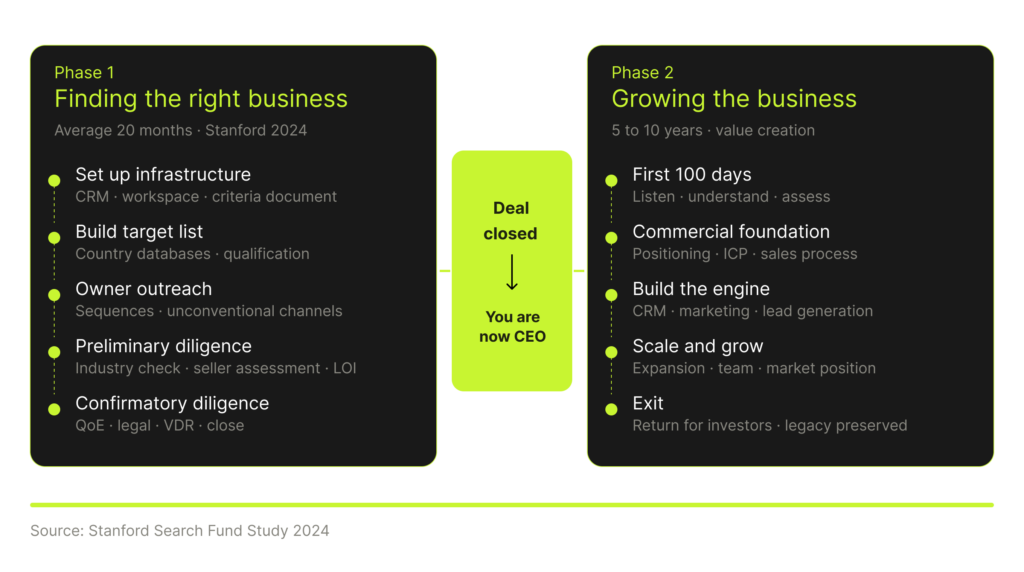
Phase 1: Finding the right business
A structured search in Europe comes down to three things working together: the right databases for your target market, a CRM that keeps your pipeline clean from day one, and a team working in the same direction with clearly divided responsibilities.
The databases vary by country. What works in Germany does not work in France. What works in Spain does not work in Italy or the UK. The intermediary networks are different. The succession marketplaces are different. The official registries that give you financial data on target companies are different. The cultural dynamics of approaching a family business owner in Munich are different from approaching one in Lyon, Madrid, Milan or Birmingham. Getting this right from the start saves months of trial and error.
The search phase takes on average twenty months according to the 2024 Stanford Search Fund Study. It requires structure, the right tools, resilience and a process that keeps improving as you learn. The Tools Directory on this site was built specifically for European searchers, covering every stage from building your first target list to managing due diligence. If you are just starting, the Getting Started Resources are the right first stop.
The moment that changes everything
Closing a deal after months of searching, due diligence and negotiation is a genuine achievement. Not every searcher gets there. One in three search funds never acquires a company despite years of full-time effort. So when you sign, it matters.
But closing is not the finish line. It is the starting gun for something different and in many ways harder.
Phase 2: Growing the business
Most acquired SMEs have strong operations, loyal customers and a business that has worked for decades. What they rarely have is a clear commercial strategy, a structured sales process or the marketing infrastructure to grow beyond the founder’s personal network.
The founder knew every customer by name. They won business through relationships built over years. They priced by instinct and it worked. None of that transfers automatically to a new CEO, however capable.
The first hundred days are about understanding before acting. Who are the real customers and why do they stay? What does the sales process actually look like versus what people say it looks like? Where is revenue genuinely coming from and how fragile is it? The answers shape everything that follows: the positioning, the commercial priorities, the tools you put in place and the team you build around you.
This phase is less documented than the search phase. There are fewer resources, fewer communities and fewer people who have been through it and written about it honestly. That is the gap this site is starting to fill.
What you will find here
Search Fund Growth covers both phases of the journey. The tools directory gives European searchers a practical reference for every stage of the search. The articles and guides cover the operational and commercial challenges that do not appear in financial models: how to structure your search from day one, how to reach SME owners through channels most searchers overlook, what the post-acquisition commercial challenge actually looks like and how to approach it.
Everything here is built for the European context.
If you are navigating your search or building your business after acquisition, we are glad to hear from you.