

Most searchers start with the same playbook. They set up their CRM, build a target list from databases, write an outreach sequence and start sending emails. Some add cold calling. Some register a buyer profile on Deale or nexxt-change. Some reach out to brokers and intermediaries. Some tap their investor network and alumni connections for warm introductions.
This is the right starting point and none of it should be abandoned. But it is also what every other searcher in your market is doing. The owners who receive the most value from a well-structured search are often the ones who are not being reached through the standard channels at all.
This article covers the channels that most searchers overlook, why they work and how to use them practically.
Part 1: The standard playbook
Before going beyond it, it is worth being honest about what the standard playbook is and why it works up to a point.
- Cold email sequences are the backbone of most searches. A structured sequence of three to five personalised touchpoints over two to three weeks, managed through a CRM or a dedicated outreach tool, is the most scalable way to reach a large number of owners systematically. The Stanford Search Fund Best Practices document identifies email as one of the primary outreach methods precisely because it allows a searcher to reach thousands of companies efficiently. The limitation is that it is increasingly competitive: owners in attractive sectors receive multiple approaches from multiple buyers and the signal-to-noise ratio is declining.
- Cold calling is less commonly used but the Stanford Best Practices document explicitly identifies it as effective depending on personal comfort and preference. The hit rate per contact is higher than email because fewer searchers use it and because a real conversation is harder to ignore than an email. It is particularly relevant in Germany where Mittelstand owners often respond better to a direct phone conversation than to an unsolicited email, and where the formality of a well-prepared call signals seriousness. The limitation is that it does not scale the way email does.
- Marketplace listings and buyer profiles on platforms like Deale, nexxt-change, Fusacq and CessionPME generate passive inbound deal flow from owners who have already decided to sell. Worth maintaining but not a substitute for proactive outreach.
- Broker and intermediary outreach gives a searcher access to deal flow that never appears on public platforms. Building relationships with the M&A advisors, accountants and notaires who represent sellers in your target sector is a standard part of any search. The Stanford document recommends spending roughly 20% of search time on intermediated deal flow.
- LinkedIn direct outreach reaches owners who are active on the platform, which signals some openness to professional contact. Response rates are modest but higher than cold email for some sectors and geographies.
- Chambers of commerce and trade associations run events, sector working groups and in some cases explicit succession matching programmes. Registering as a buyer with the relevant chamber in your target region is a known channel with low competition.
- Investor network introductions are the most underused of the standard channels. The Stanford Best Practices document explicitly recommends leveraging your investor group to generate introductions. Each investor typically has a network of business owners, advisors and operators built over decades. A searcher who systematically asks each investor for two or three introductions per month generates warm deal flow without any cold outreach.
- Alumni network outreach through business school and university networks is a known channel in the search fund community. A shared educational background is a genuine warm introduction trigger, particularly in France where Grandes Écoles networks carry significant weight in business relationships.
Part 2: Beyond the standard playbook
The channels below are used by some searchers but not systematically. Each one requires a different kind of effort from cold email but can generate deal flow that is genuinely proprietary: conversations with owners who are not on any platform, not working with a broker and not being contacted by anyone else.
Trade fairs and sector events
A searcher who has committed to a specific sector has one significant advantage over a generalist acquirer: they can go where the owners are.
Every sector has its trade fairs, annual conferences and regional events where business owners gather to meet suppliers, stay current on industry developments and see competitors. These are not networking events for buyers. They are working events for operators. That is exactly what makes them valuable.
An owner you meet at a sector trade fair is meeting you in a context where they are thinking about their business, not fielding an acquisition approach. The conversation starts differently. You are a fellow person interested in the sector, not another email in their inbox. If the conversation goes well and you stay in touch, the relationship exists before any acquisition intent is declared.
The practical approach: identify the one or two most relevant trade fairs for your target sector in your target country. Attend as a visitor or, if budget allows, as an exhibitor if exhibitor lists reveal that smaller owner-managed businesses participate. Use the visit to build sector knowledge as much as to make contacts. The owners you meet become part of your network regardless of whether they are ever acquisition targets.
Accountants, notaires and tax advisors
This is the highest-value unconventional channel available to a European searcher and the most underused.
In France, Spain and Germany, the accountant or tax advisor is often the most trusted professional advisor an SME owner has. They know the business intimately. They know the owner’s financial situation, family circumstances and succession intentions. They are frequently the first person an owner speaks to when they start thinking about selling, often years before anyone else knows.
A searcher who builds genuine relationships with two or three well-networked accountants in their target sector and geography has access to succession information that never reaches any marketplace or broker. The introduction, when it comes, carries the full weight of a trusted advisor recommending a credible buyer.
The practical approach is to approach accountants not as referral sources but as sector experts. Request a meeting to understand the landscape of businesses in your target sector. Ask about typical ownership structures, common succession challenges and what owners in the sector tend to care about when they think about exit. Build a genuine relationship before any ask. Accountants who trust a searcher’s judgment and professionalism will think of them when a client raises the topic of succession.
In France, notaires play a similar role and are often more directly involved in business transfers than in other countries. In Spain, gestorías have deep relationships with small business owners and are worth approaching with the same mindset.
Industry suppliers and distributors
Every SME in your target sector has suppliers: companies that sell them raw materials, equipment, software or services. Those suppliers have direct commercial relationships with the owners you want to reach. They know which businesses are growing, which are stagnating and which owners have been making comments about wanting to step back.
A warm introduction from a supplier carries more credibility than any cold outreach because it comes from someone the owner already trusts in a business context. A supplier who has been selling to an owner for fifteen years and introduces a credible buyer is doing the owner a favour, not facilitating a transaction.
The practical approach: identify the key suppliers and distributors in your target sector. These are often visible from trade fair exhibitor lists, sector association directories or simply from conversations with the first owners you meet. Approach them as someone interested in the sector with a long-term perspective. Explain your acquisition thesis honestly. Ask if they know of any owner-managed businesses in the sector where succession might be a topic. You are not asking them to broker a deal. You are asking whether they know anyone worth talking to.
SDR services
Some searchers outsource part of their outreach to a specialist sales development representative service rather than running all prospecting in-house. An SDR service handles the research, list-building and first-touch outreach, freeing the searcher to focus entirely on qualified conversations with owners who have expressed interest.
The honest limitation is that finding a European SDR service that understands the specific context of search fund acquisition outreach and can communicate credibly with SME owners is not straightforward. The quality of the outreach matters enormously: a poorly written or generic first contact can close a door permanently with an owner who might otherwise have been receptive.
If considering this option, any SDR service should be briefed extensively on the acquisition criteria, the searcher’s background and the specific language and tone appropriate for approaching family business owners in the target country. Start with a small pilot before committing to a full campaign.
Regional business press and media monitoring
Regional business newspapers and magazines in Germany, France and Spain regularly profile SME owners: a founder celebrating thirty years in business, a family company that just won a regional award, an entrepreneur speaking at a local chamber event. These profiles are warm outreach triggers that most searchers never use.
An owner who has just been profiled in a regional business publication has publicly spoken about their company and their role in it. A searcher who reads that profile carefully, references something specific from it and reaches out with a genuine and informed observation has a fundamentally different opening than a searcher sending a cold template to a name extracted from a database.
The practical approach: set up Google Alerts for key terms in your target sector combined with the regions you are searching in. Monitor regional business publications in your target country. In Germany this includes publications like Wirtschaftswoche regional editions and local IHK magazines. In France regional editions of Les Echos and La Tribune cover SME stories regularly. In Spain El Economista and regional business press cover family business profiles. When a relevant profile appears, read it carefully and reach out within a week while the profile is still fresh.
This channel requires consistency rather than volume. One well-researched outreach triggered by a media profile will outperform fifty generic cold emails to the same owner.
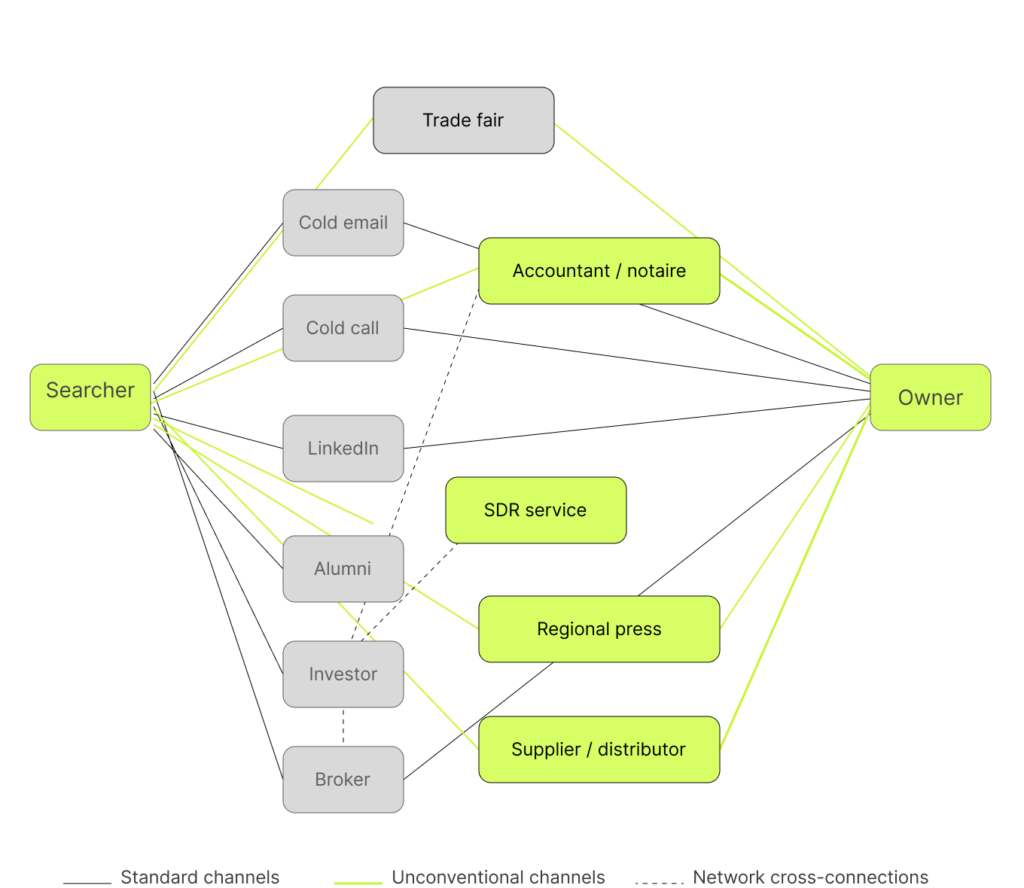
None of the channels in Part 2 scale the way a cold email sequence does. Each one requires more time, more research and more patience per contact. The return is a different quality of conversation: an owner who already has a reason to take you seriously before you have made any acquisition pitch.
The most effective searches combine the volume of the standard playbook with the quality of these less obvious channels. Cold email builds pipeline breadth. Trade fairs, accountant relationships and media monitoring build the proprietary opportunities that no other buyer is seeing.