

You signed. The deal closed. The champagne was opened. And then, usually within the first week, something goes wrong that was not visible during due diligence. A key customer calls to say they are reviewing their supplier relationships. An employee who seemed enthusiastic during the transition period hands in their notice. A financial control that everyone assumed existed turns out not to exist.
This is not bad luck. According to practitioners who have accompanied dozens of search fund CEOs through this transition, it is practically guaranteed. The question is not whether it will happen but how you respond when it does.
The first 100 days set the trajectory for your entire tenure. Not because of what you change, but because of what you learn and how you show up. This article is a practical checklist for navigating that period with clarity, specifically from a commercial perspective.
The paradox you walk into on day one
Most new search fund CEOs enter their acquired company with a paradox that takes time to fully understand. You have legal authority to make any decision. You have zero organisational capital to execute it. You own the equity. You do not own the culture.
The biggest mistake new CEOs make is trying to prove their value too quickly through visible changes.
In an SME environment where the previous owner built everything from scratch over decades, rapid change is frequently interpreted as an indictment of the past. The team that welcomed you warmly on day one will watch your first decisions very carefully. Every choice signals what kind of leader you are.
According to the IESE paper “Search Funds: What Does Not Seem to Work” (Jan Simon, February 2026), leadership failure is one of the most frequent causes of value destruction in search fund acquisitions, and it typically manifests in the first two years. The paper identifies a consistent pattern: the new CEO, eager to demonstrate competence and justify the acquisition price, acts before they understand. The result is avoidable mistakes made in conditions of incomplete information.
Your primary goal in the first month is not to fix the business. It is to understand it.
Your second goal is to do no harm.
The three-phase timeline
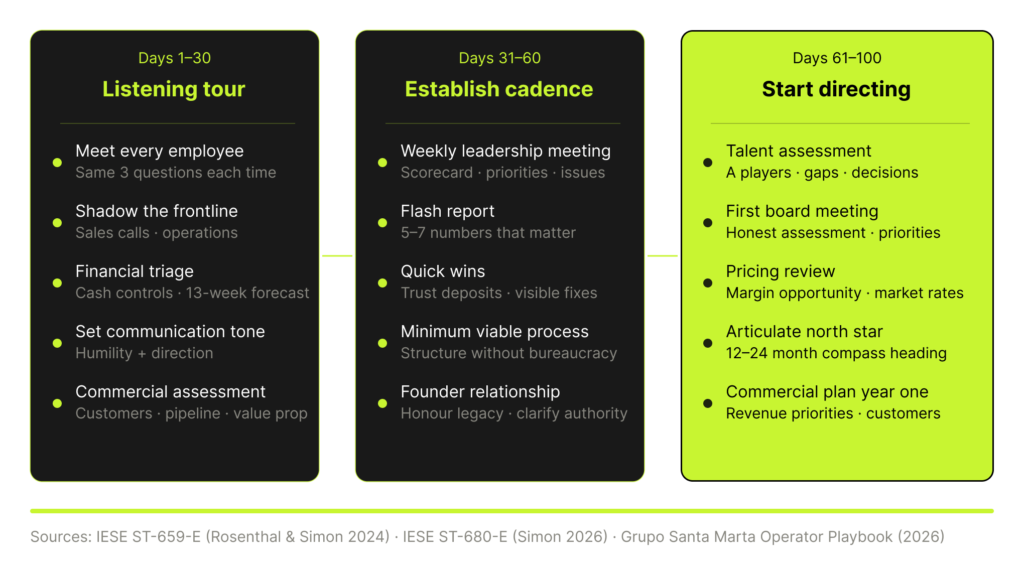
Days 1 to 30: the listening tour
Meet every employee
In the first two weeks, meet individually with every person in the business, or at minimum every manager and every customer-facing employee. Ask the same three questions to everyone: what is working well, what is broken, and if you were in my position what would you focus on first.
Take notes. Do not react. Do not commit to anything.
The goal is to build a map of the organisation as it actually is, not as it appears on an org chart.
Shadow the frontline
Go on sales calls. Sit with customer support. Walk the production floor or the service delivery operation. Spend time where the business actually meets its customers. This builds credibility faster than any town hall speech and accelerates your learning curve in ways that reading reports cannot. According to the IESE Search Fund Transformations paper (Rosenthal & Simon, 2024), high-performing search fund CEOs in their initial years spent close to 60% of their time on sales growth.
That orientation starts on day one, before you have any idea what to change.
Financial triage
While you are listening operationally, you must be rigorous financially from the first day. Verify cash controls immediately. Ensure you have daily visibility into bank balances. Build a 13-week cash flow forecast. This is not the same as understanding the P&L, which requires more time and context. It is the immediate priority of ensuring the business has no hidden cash crisis developing beneath the surface.
Set the communication tone carefully
The best opening communication with the team strikes a balance between humility and direction. Something like: I have a great deal to learn from all of you about how this business works, and I am listening carefully. At the same time, I am committed to building on what has been built here and taking it further. Do not over-promise. Do not make commitments you cannot keep in week one. The team will remember everything you say in this period and measure you against it for months.
Days 31 to 60: establish cadence
By the end of the first month you have a working map of the business.
You understand who the real operators are, where the informal authority lies, which processes run on tribal knowledge and which on actual systems, and which customer relationships are genuinely robust versus superficially cordial.
Now your job shifts. It is not yet to transform the business. It is to professionalise it without choking it. Most acquired SMEs run on informal networks, unwritten rules and the personal authority of a founder who made decisions instinctively. Your goal is to introduce what practitioners call minimum viable process: just enough structure to give the organisation a rhythm without creating bureaucracy that slows down a business that survived on speed and relationships.
The weekly leadership meeting
Install a 90-minute weekly meeting with your direct reports. A simple standard agenda works: a brief scorecard review of the five to seven numbers that matter most, a review of current priorities and where they stand, and a structured problem-solving session for whatever is stuck. The discipline of this meeting signals to the team that there is now a cadence to how the business is run, and it gives you a regular forum to identify issues before they become crises.
The flash report
Create a simple weekly dashboard that tracks the numbers that actually matter for your specific business: revenue, cash, pipeline, backlog, customer satisfaction, whatever the key operational indicators are for your sector. This is not a sophisticated reporting system. It is a one-page summary that keeps you and your team focused on what moves the business rather than what generates interesting analysis.
Quick wins
Identify two or three low-cost, high-visibility problems that you can fix immediately. A broken process that everyone complains about. A tool that does not work. An administrative burden that consumes time without producing value. Fixing these things costs little and signals that you listen, act on what you hear and deliver. These trust deposits buy you runway for the harder decisions that come later.
Days 61 to 100: start directing
By month three you know the business and the business knows you.
This is when you can begin to shift from observation to direction.
Talent assessment
You likely know by now who your strongest people are and where the gaps are. You do not need to act on everything immediately, but you need a clear internal picture of who is genuinely contributing and who is coasting on the protection of the previous owner. Some decisions on people will need to wait until you have more context. Others cannot wait. The key is to be honest with yourself about what you are seeing.
The first board meeting
Your first post-closing board meeting should not be a celebration. According to Rob Johnson’s IESE paper on what makes search funds work, investors on the board of a newly acquired company play a critical coaching role in the first two years. One of the most common interventions experienced board members make is redirecting a new CEO who is focusing too much internally, and getting them out in front of customers. Use your first board meeting to present a sober and honest assessment of what you found versus what you expected, and a clear set of priorities for the next six to twelve months.
The pricing review
One of the most consistently overlooked value creation levers in acquired SMEs is pricing. Many family-owned businesses have not raised prices in years, sometimes decades, out of habit or fear of losing customers. A systematic review of pricing against market rates and value delivered almost always reveals margin opportunity.
This does not need to happen in the first 100 days but it needs to start.
Articulate the north star
By day 100 you should be able to articulate, simply and clearly, what the business is going to look like in twelve to twenty-four months and what the three or four things are that will get it there. This is not a full strategic plan. It is a compass heading that orients the team and gives the board something concrete to hold you to.
The commercial checklist: what to assess and where to start
This is where the first 100 days become specifically commercial.
The IESE research on search fund transformations is unambiguous on this point: the overwhelming majority of value created in successful search fund acquisitions comes from revenue growth, not cost reduction or margin improvement.
Of the 31x multiple on invested capital that high-performing search fund companies created for their investors, 18.1x came from revenue growth and only 0.4x from margin expansion.
The commercial engine is where the value is.
Most acquired SMEs have a commercial situation that looks solid from the outside and is more fragile than it appears on closer inspection. Here is what to assess in the first 100 days.
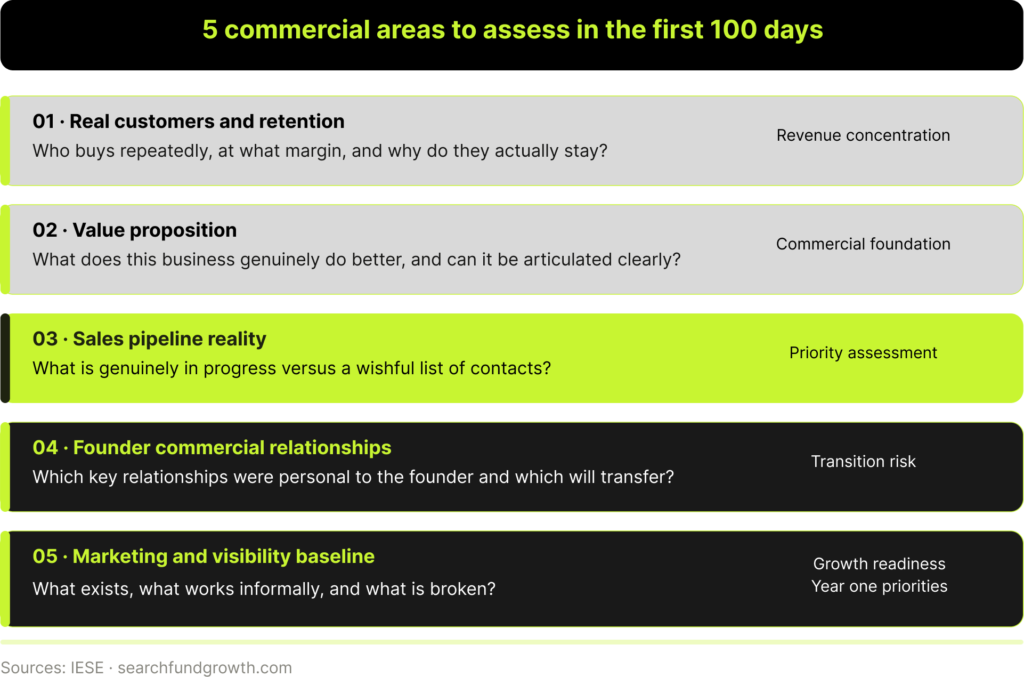
Who are the real customers and why do they actually stay
Not who is on the customer list. Not who the previous owner described as the key relationships. Who genuinely buys repeatedly, at what margin, and for what reason. In most acquired SMEs, the honest answer to this question is different from what the business believes. Customers stay because of the personal relationship with the founder, because switching costs are high, because the product is genuinely better, or because no one has called them recently to offer an alternative.
Understanding which of these is true for your most valuable customers is the most important commercial intelligence you can build in this period.
What the value proposition actually is
Most family-owned SMEs cannot articulate their value proposition clearly because the founder never needed to. They won business through reputation, relationships and decades of consistency. The new CEO inherits a business that is genuinely good at something but often cannot explain what that something is in a way that would resonate with a new customer. Getting clarity on this is a prerequisite for any commercial growth.
The state of the sales pipeline
Most acquired SMEs do not have a real sales pipeline. They have a list of contacts, a set of recurring relationships managed by the founder or a long-tenured salesperson, and a vague sense of what might be coming in. Mapping what actually exists, what is genuinely in progress and what is wishful thinking is a critical early task. The IESE paper on customer concentration (Simon, February 2026) is clear that customer concentration is one of the most frequently recurring characteristics of search fund failures.
Understanding the true concentration of your revenue, including the correlation between your top customers, is not a due diligence task you did before closing. It is an ongoing commercial management task that starts on day one.
The founder’s commercial relationships
In almost every acquired SME, the most important commercial relationships were held personally by the founder. Some of those relationships will transfer naturally. Others will need active work to preserve. And some will leave regardless of what you do, because what they were buying was not the service or the product but their personal trust in the previous owner. Identifying which is which in the first 100 days allows you to direct your energy where it can actually have an impact.
The marketing and visibility baseline
Most acquired SMEs have a website that has not been updated in years, no systematic approach to generating new leads and no clear sense of how new customers find them. This does not need to be fixed in the first 100 days. But understanding the baseline, what exists, what works even if it is informal, and what is broken, gives you the information you need to build a commercial plan for year one.
Managing the founder transition
If the previous owner is staying on for a transition period, this relationship requires careful management. According to the IESE paper on what does not seem to work in search funds (Simon, February 2026), the continuing involvement of the vendor is one of the most frequently recurring factors in cases where value was destroyed. The dynamic is well documented: the founder who sold with relief and goodwill experiences, over the weeks after closing, a progressive sense of loss. The business they built and led for decades is no longer theirs. Their team now goes to you for decisions. Their instincts and experience, which defined the company, are now being supplemented or quietly replaced.
The paper identifies the five stages of grief as a useful frame for understanding what happens: denial, anger, bargaining, depression and acceptance. Not every founder goes through all of them. But enough do that you should be prepared for a relationship that starts warmly and becomes complicated.
The practical rules are simple. Honour the founder’s legacy publicly and consistently.
Consult them privately on matters where their knowledge is genuinely valuable. Be clear from the beginning that decision-making authority has transferred. Never criticise what was built before you arrived, even when what was built has problems. Frame every change as building on a foundation, not correcting a mistake.
The golden rule is borrowed from practitioner experience across dozens of transitions: you earn your leadership not through your title but through the quality of your questions and the integrity of your actions in the first 100 days.
What the first 100 days are actually for
The IESE research on leadership in search funds describes the first year of a CEO tenure as requiring a diplomat archetype: cooperative, problem-solving, genuinely curious, able to earn trust from people who did not choose to work for you. Strategy comes later. Transformation comes later. The first 100 days are for building the organisational capital, the relationships, the knowledge and the credibility that make everything else possible.
The new CEO who enters with answers will spend months fixing the problems they created by acting before they understood. The new CEO who enters with questions will, by day 100, have a clear commercial picture, a trusted team, a functioning operational rhythm and a genuine sense of where the value is.
That is the foundation everything else is built on.