
Most searchers spend their first few weeks doing things twice. They build a target list in a spreadsheet, move it to a CRM three months later when the spreadsheet has become unmanageable, rebuild their research notes when they realise they are stored across six different documents, and wonder why the process feels so chaotic.
The setup problem is real and it costs more time than most searchers expect.
This article is about getting your search operation right from the start: which tools to put in place, how to divide work with your team and what a realistic weekly rhythm looks like.
Start with the infrastructure, not the targets
The instinct on day one is to start searching. Resist it for the first week.
The time you invest in setting up a clean, coherent system in week one will save you months of friction later.
You need four things in place before you contact anyone:
A professional email address on your own domain
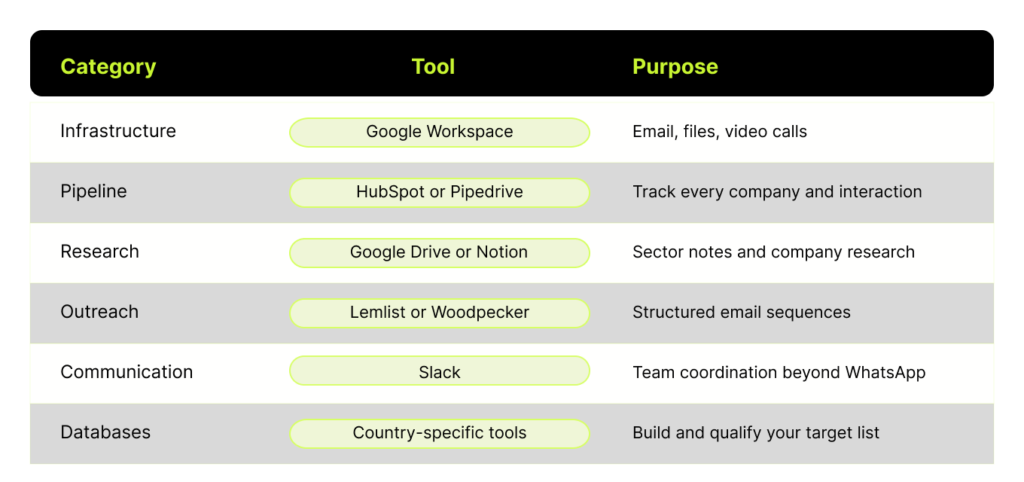
Not a personal Gmail account. Owners and intermediaries judge credibility from the first email, and a personal address signals that this is not a serious operation. Set up Google Workspace on your own domain. It takes less than an hour and costs €7 per user per month on the annual Business Starter plan. This also gives you Drive for file storage, Meet for video calls and Sheets for financial screening.
A CRM to track every company and every interaction
The biggest mistake searchers make is starting with a spreadsheet and migrating to a CRM three months later when the data has become unmanageable.
Start with the CRM from day one. For most European searchers with a small team, the HubSpot free tier is the right starting point: it handles contact management, deal pipeline, email logging and basic outreach sequences without any technical setup. If you prefer something simpler and more visual, Pipedrive is a strong alternative. Both integrate directly with Google Workspace.
A shared space where research lives
Your CRM tracks interactions with individual companies. What it handles less well is the knowledge that builds across companies and across time: your growing understanding of a sector, patterns observed across multiple targets, the outreach messages that get responses, the team’s evolving investment thesis. That knowledge needs a shared home. Google Drive is sufficient for most teams: a folder structure with a sector research document, an outreach learning log, a criteria document and a running investor update draft covers the essentials. If your research volume grows and you find yourself spending time cross-referencing information across sectors and companies, Notion is worth considering. Its linked database structure connects related information across companies, sectors and themes in a way that Google Docs cannot replicate cleanly. Start with what you already have and add tools only when the friction becomes real.
A communication channel for your team
Most European searcher teams communicate daily by email and WhatsApp. Email for anything formal: owner outreach, investor updates, advisor coordination. WhatsApp for everything quick: checking in with trainees, sharing a link, confirming a call time. Slack becomes worth adding when the team reaches two or three trainees and informal WhatsApp threads start losing important information. The structural advantage of Slack is organisation: a channel for active targets, a channel for outreach campaigns, a channel for general coordination. Information does not get buried in a single thread, and new trainees can read the history and understand the context without needing the searcher to brief them from scratch. The free tier covers everything a small team needs throughout most of the search phase. One rule regardless of which tools you use: sensitive deal information stays out of WhatsApp. Owner names tied to financial details, LOI terms, confidential company data: these belong in email or in your VDR once you are in due diligence.
Define your search criteria before you build your target list
Before you open any database, write your acquisition criteria in a single shared document that the whole team can see and refer to. This is not a formality. The Stanford Search Fund Primer is explicit on this: it is difficult to be credible, thoughtful and engaged in more than one to three industries at any one time. Spreading across too many sectors is one of the most common ways searchers waste the first months of their search.
The Stanford Primer and the IESE Search Fund resources in our Getting Started section both provide frameworks for thinking through criteria. The specific parameters will depend on your investor mandate and personal conviction, but your criteria document should cover five areas.
Sector focus
Two to three sectors maximum, chosen because you have relevant experience or genuine conviction. Rob Johnson’s widely cited IESE paper on search fund best practices identifies two sector characteristics that matter most: the industry should be growing, and it should be fragmented enough that a regional operator has a genuine advantage over national competitors.
Financial parameters
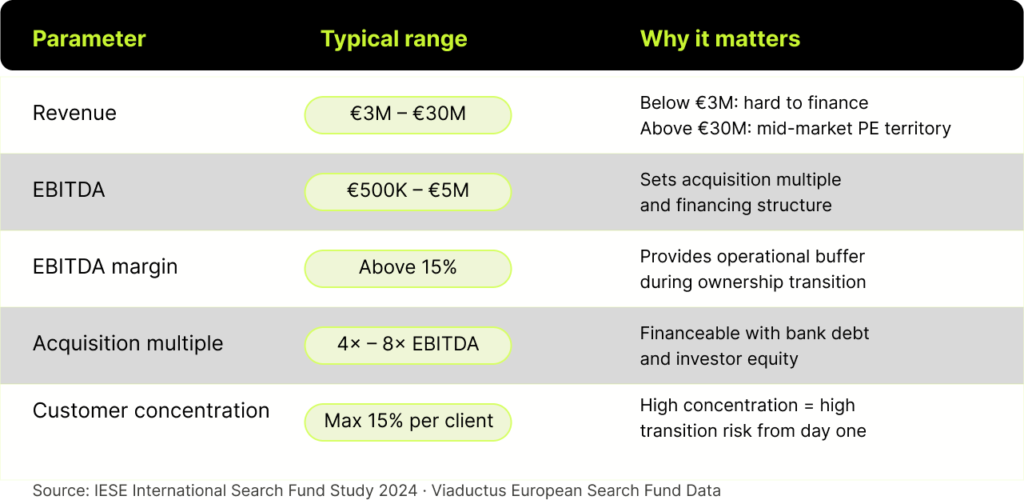
Based on data from the 2024 IESE International Search Fund study, the median European search fund acquisition had revenues of approximately €7 to €8 million, an EBITDA margin of 24% and a purchase multiple of 5.7x EBITDA.
The practical range for a financeable European acquisition sits between €3 million and €30 million in revenue, with EBITDA between €500,000 and €5 million.
Revenue quality
Recurring or repeat revenue is the strongest predictor of business resilience during an ownership transition. A business where the top three customers represent 60% of turnover is one where the first six months as CEO will be spent managing customer retention anxiety rather than building anything.
Owner situation
You are looking for an owner who is ready to transition for genuine and durable reasons: retirement, succession without a family heir, desire to exit after building something. Owners selling under financial distress or owners who are not truly ready to leave generate the most difficult transitions.
Deal-breakers
Write these down explicitly: high customer concentration, businesses entirely dependent on the founder’s personal relationships, capital-intensive businesses requiring significant ongoing reinvestment, sectors in structural decline.
Having these written down saves trainees from spending time researching companies that will never pass your first filter.
Build your target list using the right databases
The databases you use depend on your target market. European search fund databases are country-specific: a tool that is essential in Germany may be entirely irrelevant in France. Use the tools built for your market.
For Germany
Northdata is the most practical free starting point for company research and financial screening. nexxt-change is the institutional succession marketplace where owners actively listing their businesses can be found, with over 22,000 successful transfers since 2006. Creditreform adds credit and financial depth for target verification.
For France
Pappers is the free French company database, the essential first tool for building a qualified target list from official registry data. Fusacq and CessionPME cover the marketplace side, where businesses are actively listed for sale by owners and their advisors.
For Spain:
eInforma is the primary research and verification tool, backed by Informa D&B and covering over 7 million Spanish companies. Deale is the most purpose-built Spanish SME acquisition marketplace, with over 6,000 verified companies for sale and deal sizes that directly match the search fund model.
From database to active conversation: the four-stage flow
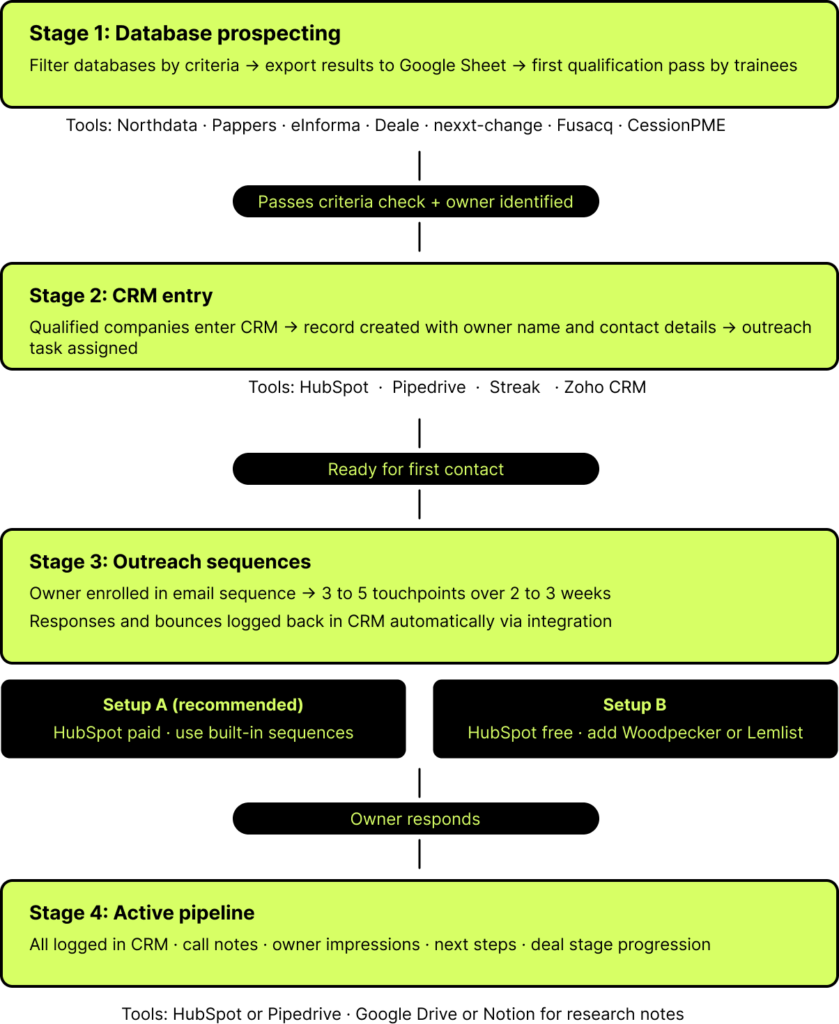
Understanding which tool does what at which moment prevents the most common operational mistake: importing everything into one place and losing track of where real opportunities are versus raw data.
Stage 1 is prospecting
The databases are where you find and screen companies. The output is a Google Sheet longlist, not a CRM import. Trainees work through the sheet to verify basic criteria and identify the owner before anything moves further.
Stage 2 is qualification
A company enters the CRM only when it has passed the criteria check and a specific owner has been identified with contact details. This keeps the CRM clean: every record is a real opportunity, not a raw data point.
Stage 3 is outreach
Once a company is in the CRM, the owner is enrolled in a structured email sequence of three to five touchpoints over two to three weeks. Two setups work here. If you are on a paid HubSpot plan, use HubSpot sequences directly and keep everything in one tool. If you are on HubSpot free, add Woodpecker for simplicity or Lemlist if you want to add LinkedIn touchpoints to your sequences. Responses feed back into the CRM automatically through the integration.
Stage 4 is the active pipeline
Once an owner responds and a real conversation begins, everything is logged manually in the CRM: call notes, owner impressions, next steps, deal stage progression. Research notes and sector knowledge live in Google Drive or Notion, not in the CRM.
Divide work clearly with your trainees
According to the Stanford Search Fund Best Practices document, interns are critical to the search phase, specifically for the tedious and time-intensive work of finding company names, descriptions, owners and contact information. The same document notes that a searcher should spend only one day or less per week on managing interns, brokered deals and pipeline administration, reserving the other four days for the proprietary search process itself. That time balance only works if intern tasks are defined clearly enough that they require minimal supervision.
A division that works in practice:
The searcher owns the search criteria, investor relationships, owner conversations from the first substantive dialogue onwards, and all decisions about which companies to pursue or drop. The searcher also owns the sector research and the industry knowledge that accumulates through owner meetings.
Trainees own the tedious but essential work that the Stanford document describes: finding company names, verifying ownership, locating contact information, doing the first qualification pass against the criteria document, setting up CRM records and logging all outreach activity. First-touch outreach goes out under the searcher’s name but trainees prepare and queue it.
Every task a trainee completes should produce a consistent, predictable output. A company research note should always have the same structure. An outreach sequence should always use the same approved templates. A CRM record should always be updated in the same way after every interaction. Consistency is what makes the operation scalable and what makes it possible for the searcher to supervise effectively in under an hour a day.
A shared onboarding document covering the search thesis, target criteria, outreach process, tools used and expectations saves many hours of repeated explanation every time a new trainee joins the team.
Build a weekly rhythm and stick to it
The Stanford Best Practices document is explicit on this point: a searcher should decide whether to work on a day-based or week-based schedule where every day or every week looks the same. The reasoning is that structure helps a searcher maintain focus and avoid the most common time trap of the search phase, spending too much time analysing deals before qualifying whether the owner is even a seller.
The document offers a sample daily schedule as a starting point. Adapted for a European search fund team with trainees, a weekly rhythm that works looks like this:
Monday: team sync
Thirty minutes maximum. Review the pipeline in the CRM: how many companies in each stage, what moved last week, what is stuck and why, what the priorities are for the week. Assign specific tasks to trainees before the meeting ends so everyone starts Tuesday with clarity.
Tuesday to Thursday: execution
This is where the 80% of time that the Stanford document allocates to the proprietary search process happens. Trainees work the database screening and outreach pipeline. The searcher handles owner conversations, prepares for meetings, conducts sector research and updates investors. New companies go into the Google Sheet screening buffer, not directly into the CRM.
Friday: review and learn
Thirty minutes. The Stanford document notes that searchers become significantly better at the process over time, but only if they actively reflect and iterate. Use Friday to update your shared research notes with the week’s learnings: which sectors are generating conversations, which outreach messages are getting responses, what objections owners are raising. This weekly reflection is the difference between a searcher who improves steadily and one who runs the same playbook for 20 months without adjustment.
According to the 2024 Stanford Search Fund Study, the median time to acquire a company is 20 months. The searchers who use that time efficiently are not the ones who work the hardest. They are the ones who build a system and protect it.